A little more from THE Things We Don’t Say—the companion guides, bonus conversations, and extras that don’t make it into the regular feed.
THIS WEEK’S EXTRAS
Episode 13: The Re-Record
There’s a pair of Jessica Simpson stilettos in the back of my closet that I cannot make myself give away, and this week I realized shoes aren’t the only thing we hang on to after they stop fitting. This one is about the old versions of us: the ones we’ve outgrown, and the ones other people won’t let us outgrow. I talk about a pastor I didn’t expect to be proud of, a word that got attached to my family, a poster I’ll never forget, and the old name tag I’ve been holding for somebody else.
Try this week
1. Name the label. Write down one word someone attached to you that you’re still trying to disprove, then ask yourself who’s really writing your story.
2. Catch your “that’s just how I am.” The next time you hear yourself say it, pause and ask whether it’s honest or it’s a cop-out.
3. Make one thing right. If someone came to mind while you listened, go to them first, just the two of you, the way Matthew 18 lays it out.
4. Retire one old name tag. Pick one person you still introduce by their worst chapter, and stop. You can keep the boundary and still give the dignity.
5. Check your posture. The next time your old name tag gets exposed, notice which one you reach for: hide, defend, or let people watch you become someone new.
Go deeper
Companion Guide:
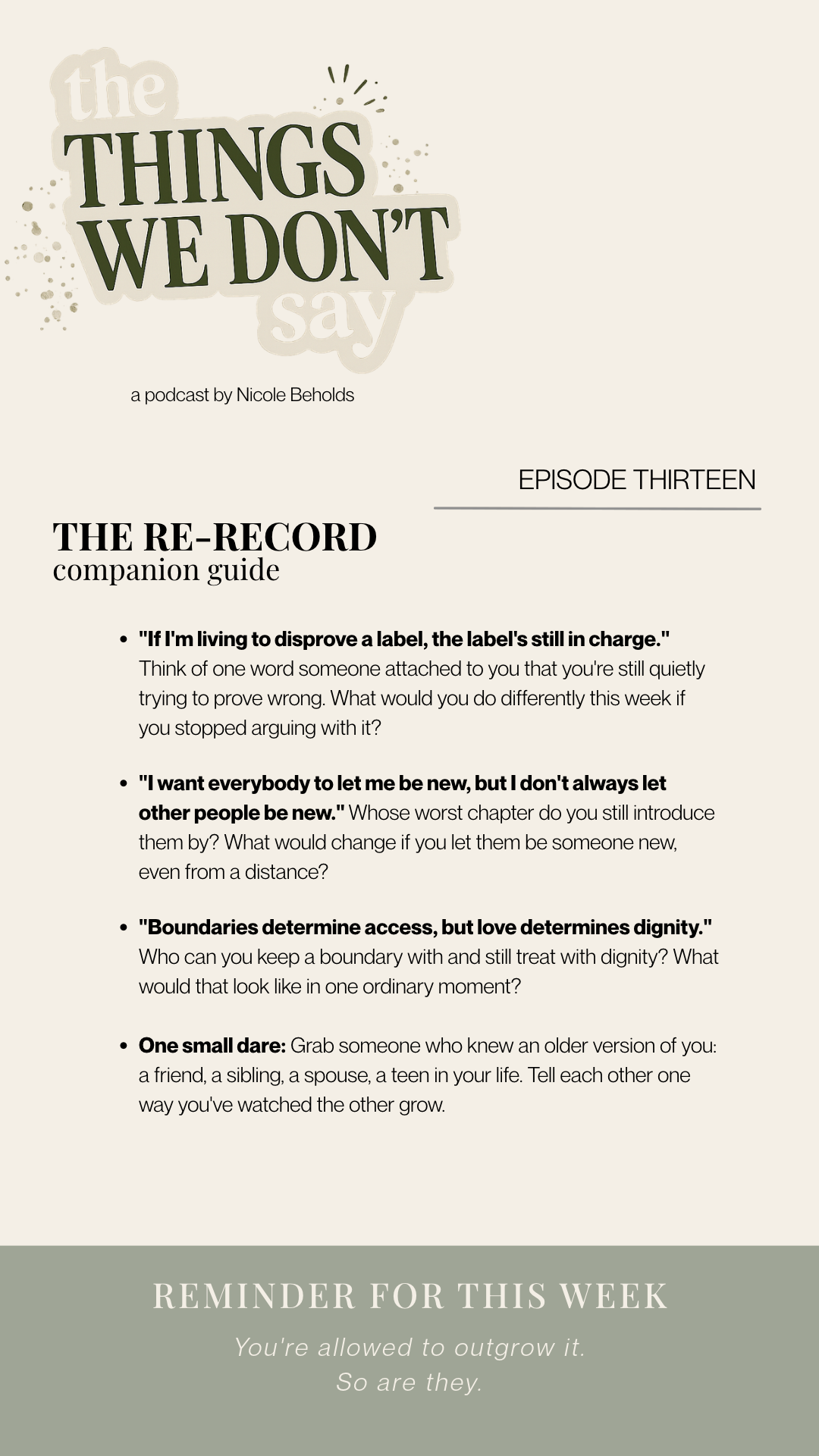
Three lines from this episode, the questions that came with them, and one small dare.
The Mel Robbins Podcast with Carl Lentz: the conversation I listened to before I made up my mind.
The Secrets of Hillsong: the four-part docuseries on Hulu, if you want the backstory. Episode two is the one I mentioned.
The verses I mentioned: 1 Peter 3:13–16, 2 Corinthians 5:17, Matthew 18:15–17, Matthew 19:9, and James 3:1.
PAST EXTRAS & COMPANION GUIDES
Episode 12: It Started with a DM
This week I read a survivor’s story out loud, word for word. Her name has been changed. She was fourteen, she loved to dance, and it started with someone telling her she was a beautiful dancer. I walk back through every step of it, share four myths I believed myself, and then my friend Brittany from South Ridge Church tells you why our church partnered with A21 and how you can come to our Global Freedom Summit viewing on Monday, October 26. Whether you’re a parent, a grandparent, a coach, or a teenager with a phone in your pocket, this one is for you.
What to do this week
1. Have the talk before it’s needed. Tell the kids in your life what grooming looks like: a stranger (or adult) with lots of compliments, someone who wants it kept secret, someone who rushes you, someone offering something that sounds too good to be true. Name it so they recognize it.
2. Say the no-shame promise out loud. “If anything online (or elsewhere) ever makes you uncomfortable, you can tell me, and you will not be in trouble for telling me.” Then keep it.
3. Learn where they actually talk. Not just which apps. Which games. Which chats. It moves from one platform to the next.
4. Keep the fence and add the conversation. Leave the parental controls on. Then talk anyway, because a fence can’t have a conversation with your kid.
5. If you’re a teenager, pick your person. Decide now who you’d tell if something online ever felt off: a parent, a youth leader, a coach, a school counselor. Telling isn’t tattling. It’s using your voice. If you’re a parent or mentor, help your child identify other safe adults they can go to if they’re nervous to come to you.
6. Save the numbers in your phone. If someone is in immediate danger, call 911. If it involves a child, call the National Center for Missing & Exploited Children at 1-800-THE-LOST (1-800-843-5678) or report at report.cybertip.org. For any trafficking concern, call the National Human Trafficking Hotline at 1-888-373-7888 or text 233733.
Go deeper
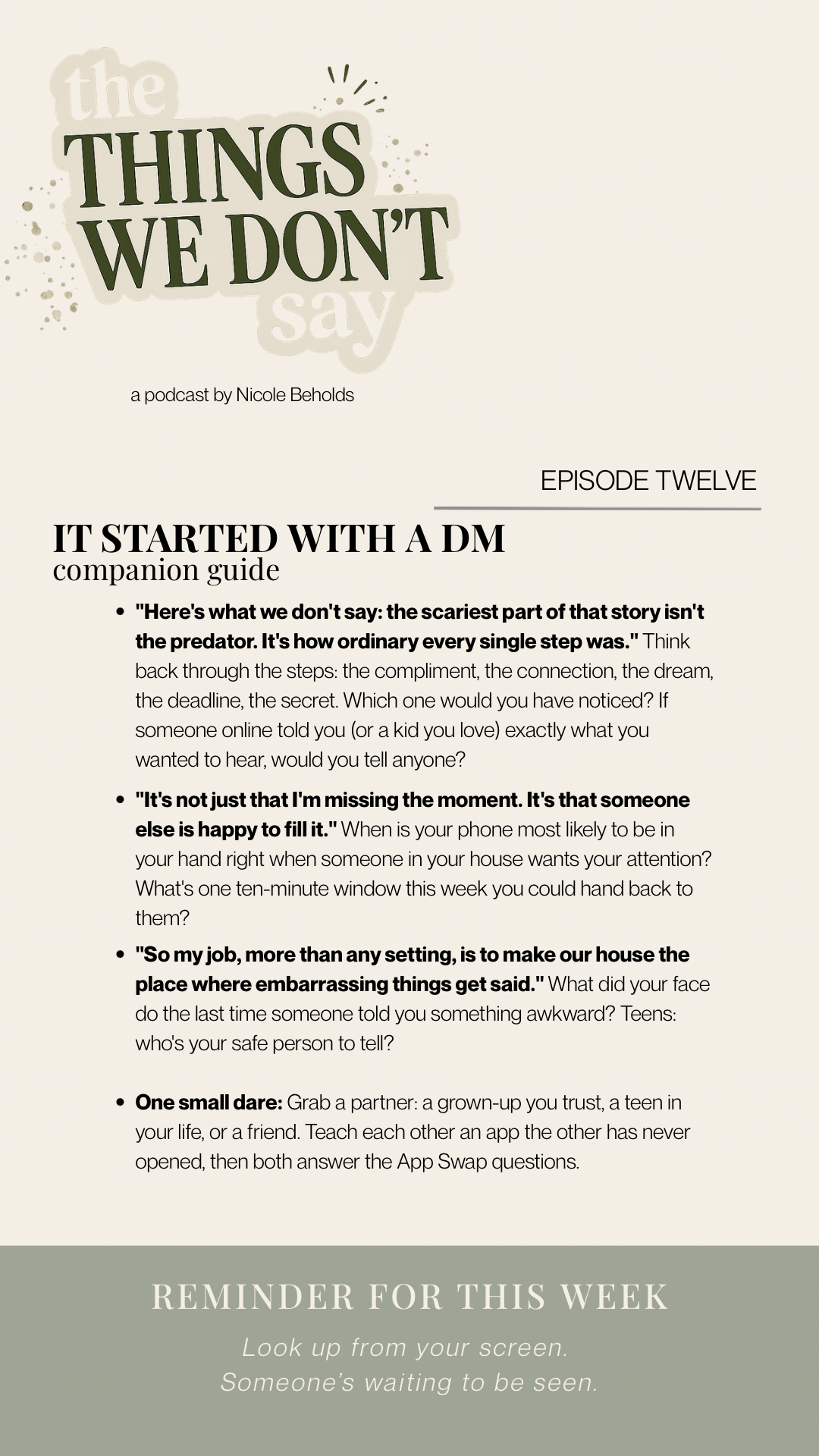
Companion Guide
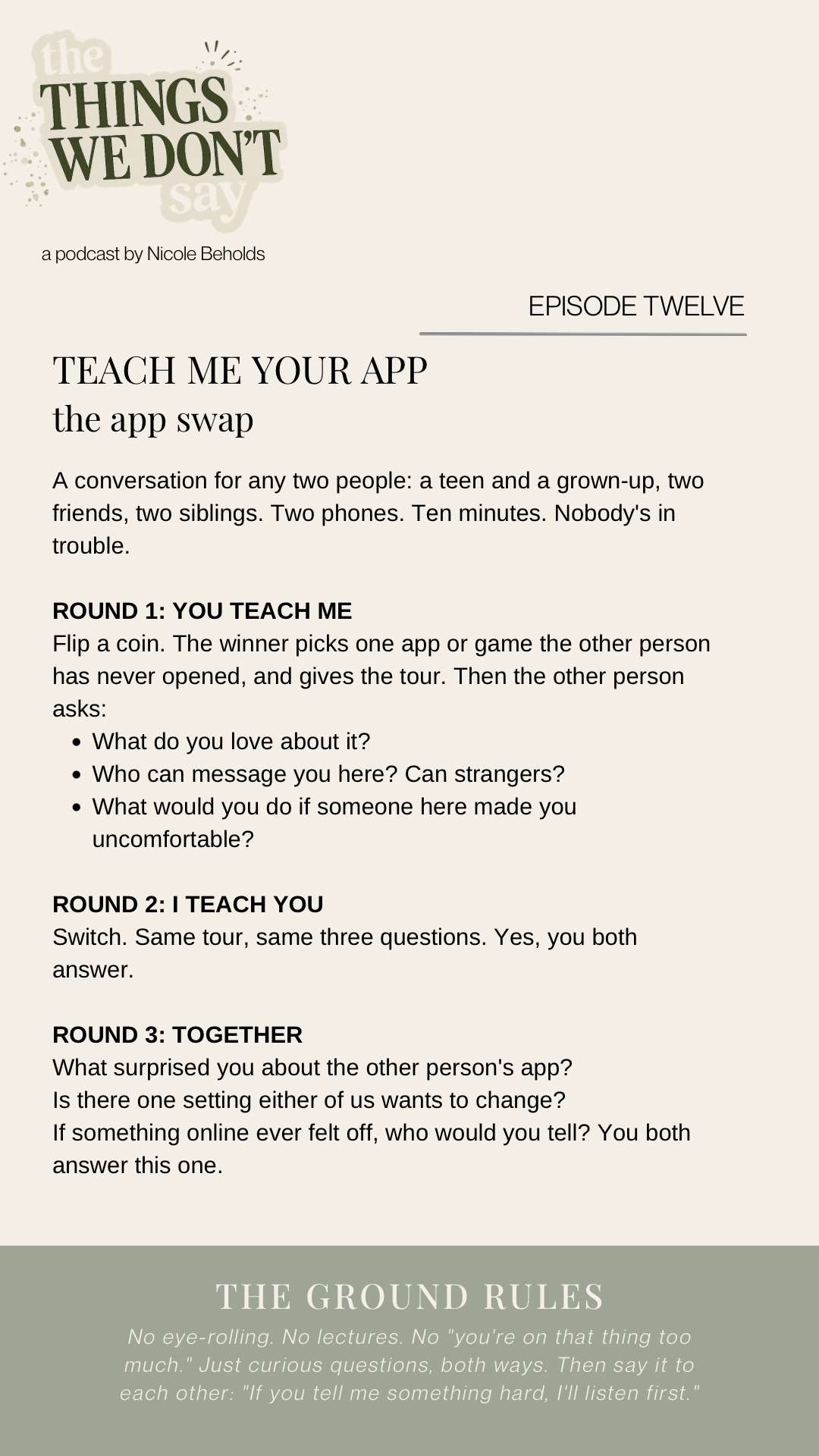
The App Swap
a ten-minute conversation for any two people: a teen and a grown-up, two friends, two siblings. You each teach the other an app they’ve never opened, and you both answer the same questions.
A21 Parent Guide for Kids and Teens: A21’s free guide to talking with your kids about staying safe. There’s also a free e-course version.
A21 Digital Safety Guide: A21’s free guide to what’s happening online and what you can do. Teens can take it as a free e-course too.
Staying Safe Online comic book: A21’s free comic for kids ages 6 to 12. Read it online, or grab the print-at-home version.
Steps to Staying Safe storybook: A21’s free storybook for younger children. There’s a print-at-home version too.
Can You See Me?: A21’s public awareness campaign.
Watch the Global Freedom Summit: stream it on A21’s website if you can’t be there in person.
Global Freedom Summit viewing at South Ridge Church: Monday, October 26, 7:00 PM, in the auditorium (2012 International Parkway, Fredericksburg, VA). Middle and high schoolers welcome. Find out more.
Report a concern (A21): a21.org/reportnow
Where the numbers come from
Thorn, Online Grooming research (2022)
Together Freedom, Trafficking Facts & Statistics (based on Polaris data)
Thorn, What the 2024 NCMEC CyberTipline Report Says About Child Safety
Virginia Mercury, Virginia human trafficking cases increased last year (Sept 19, 2025)
National Human Trafficking Hotline, Texas statistics
National Human Trafficking Hotline, South Dakota statistics
Episode 11: Available to Everyone, Present for No One
This one’s me, caught in the act. All season I’ve been talking about connection, presence, and slowing down enough to notice the people right in front of us. And this week I noticed I’ve been living the exact opposite, one little pickup at a time. It’s not a throw-your-phone-in-a-lake episode. It’s an honest, slightly embarrassing look at digital distractions, what the screen in my hand has been quietly taking from my people, and why “tomorrow” isn’t the fix I keep pretending it is.
Try this week
Check your pickups. Not your screen time hours, your pickups. Just look. No shame, just noticing.
Pick your Brick. Name the one small thing you already know would help, and set it up today instead of tomorrow.
Protect one hour. Choose one regular stretch of time with someone you love and leave the phone in another room for all of it.
Put someone in charge. Ask a kid, a spouse, or a friend to call you out when the phone comes back out. They’ll enjoy it more than you think.
Notice who’s leaning over. When someone wants to see what’s on your screen, try looking up at them instead.
Go deeper
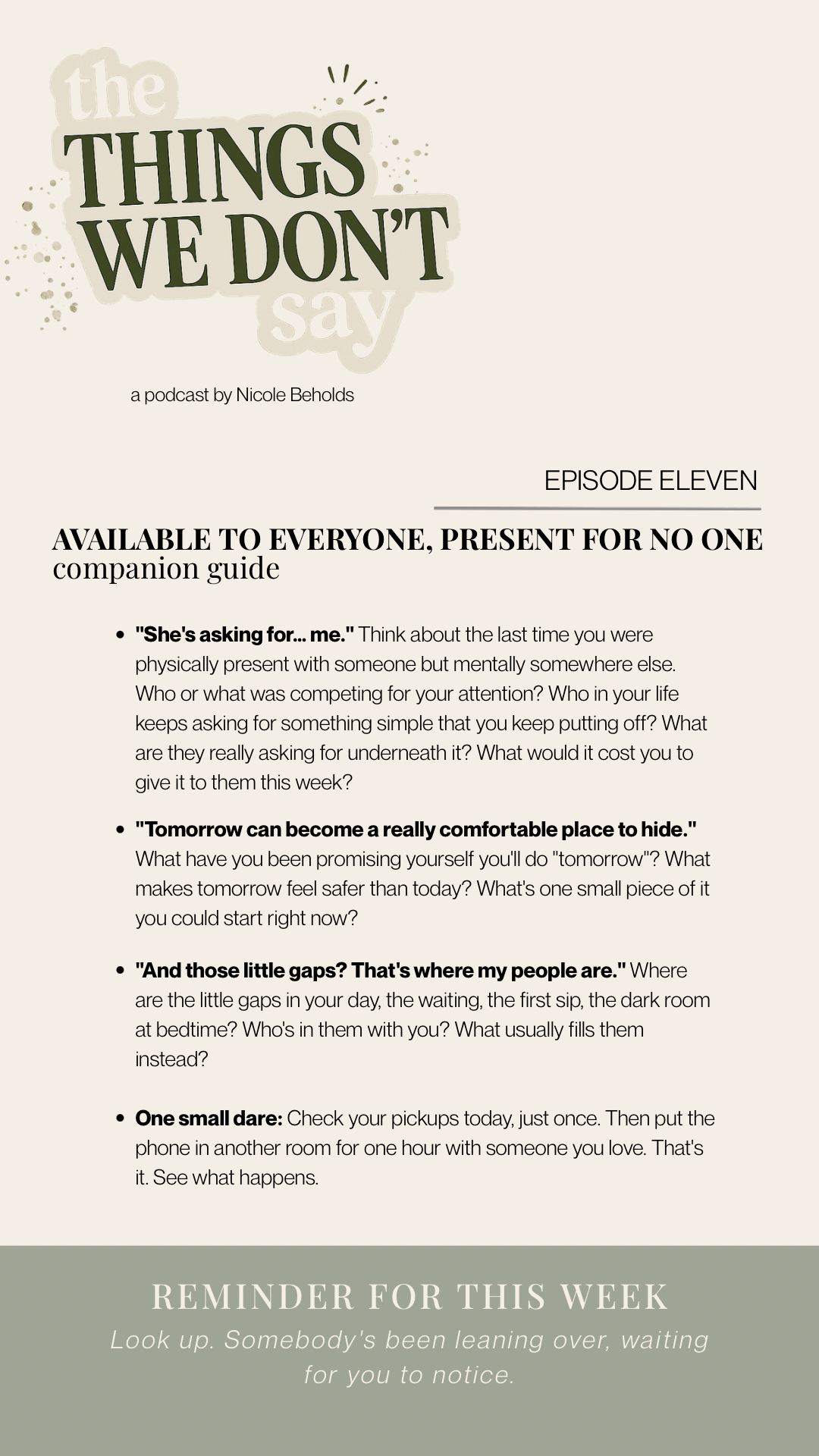
Companion Guide
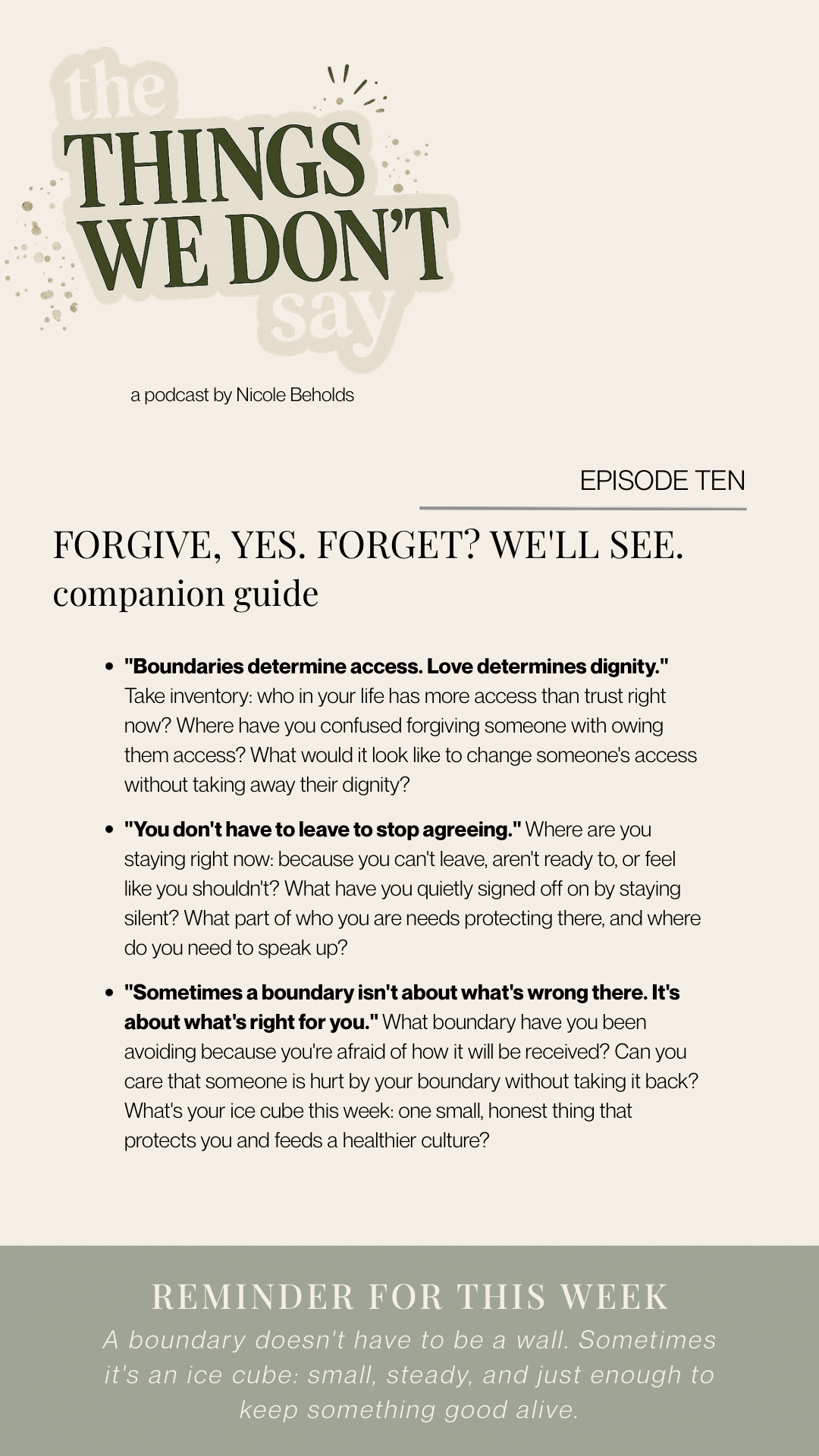
Episode 10: Forgive, Yes. Forget? We’ll See.
What happens when you can’t just leave a place or a person, or you’re not ready to, or you feel like you shouldn’t? This episode is about boundaries that let you stay. Nicole talks about the voices that make boundaries feel wrong (“forgive and forget,” “family is family”), the difference between a boundary and avoidance, and why changing someone’s access doesn’t mean you stopped loving them.
Action steps for this week
Name one place where you’ve been making yourself smaller just to fit in the room.
Decide what you’re staying for and what would make you go, while you’re calm, not in the parking lot after something happens.
Pause, pray, and then proceed before your next hard conversation. Let your big emotions ride along, but don’t let them drive.
Say one boundary clearly, kindly, and once. Then give it time instead of presenting more evidence.
Notice who has been quietly keeping something good alive in your life, and where you stopped.
Go Deeper
Companion Guide
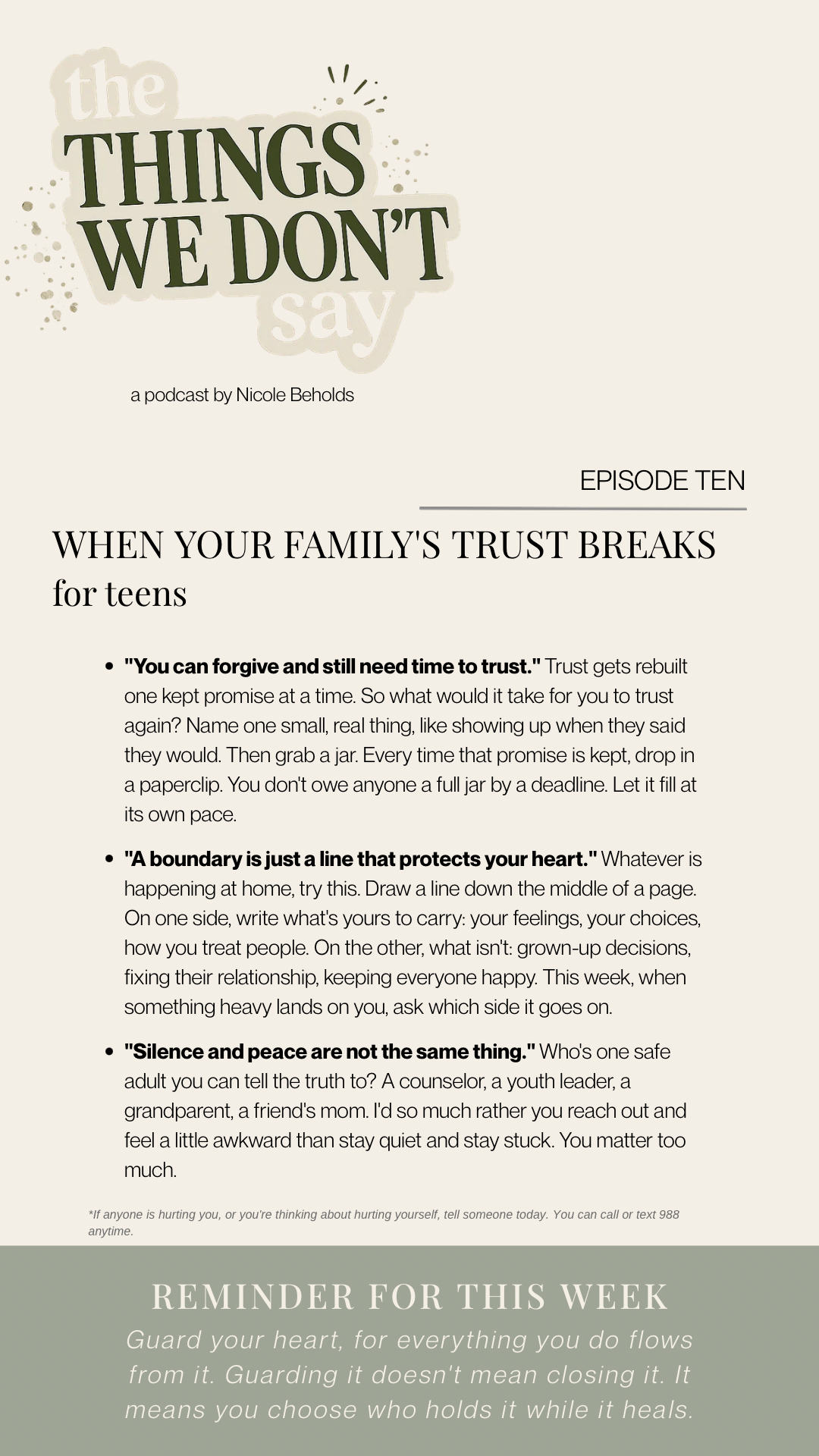
Companion Guide (for teens)
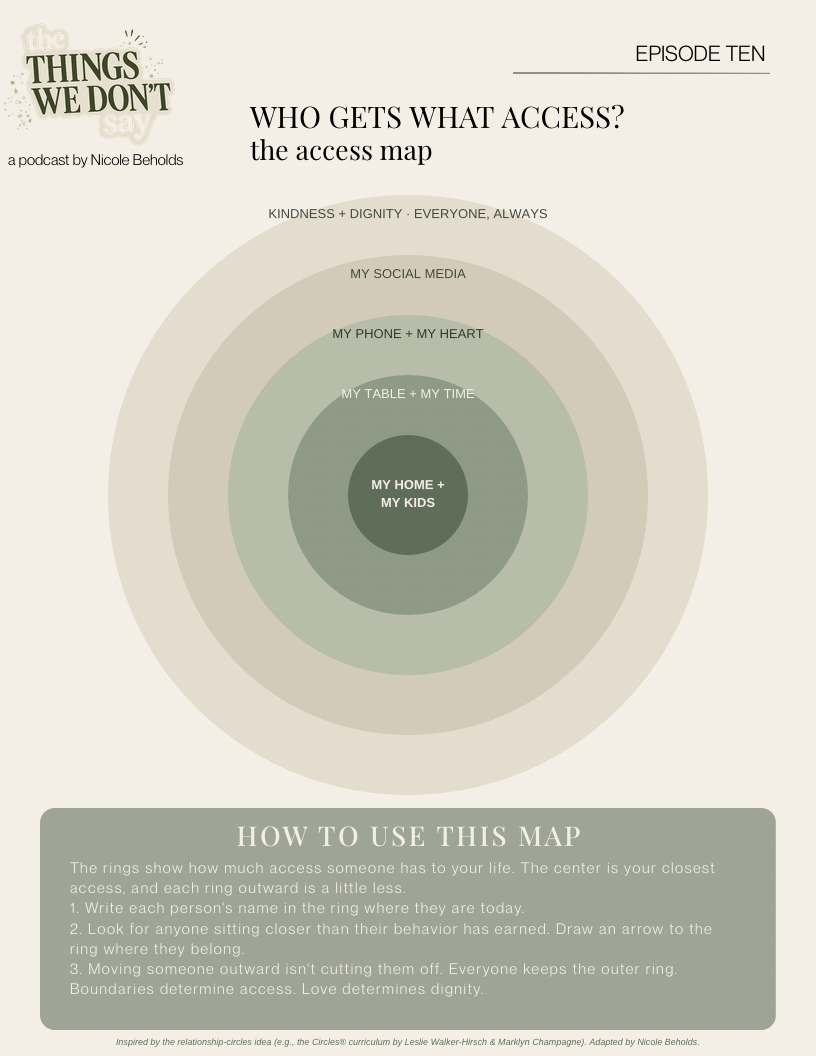
Access Map
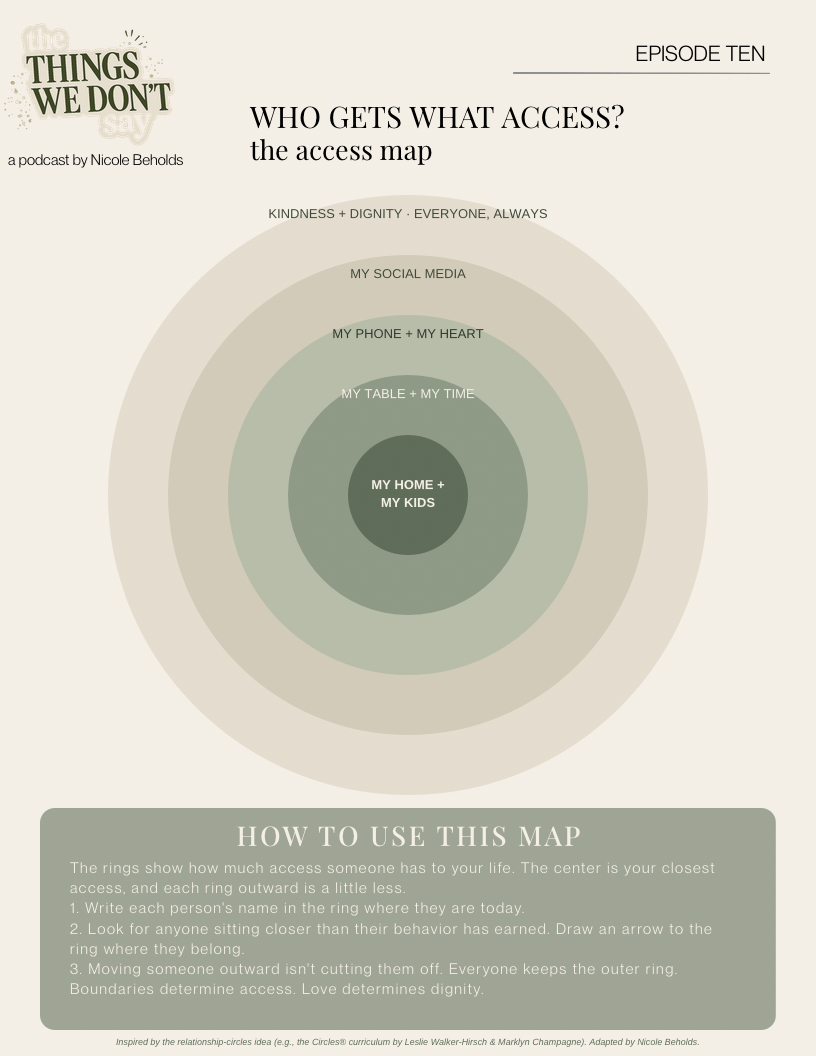
A printable page to help you see who has access to what parts of your life (your time, your home, your kids, your story, your heart) and whether that access still fits where things are now.
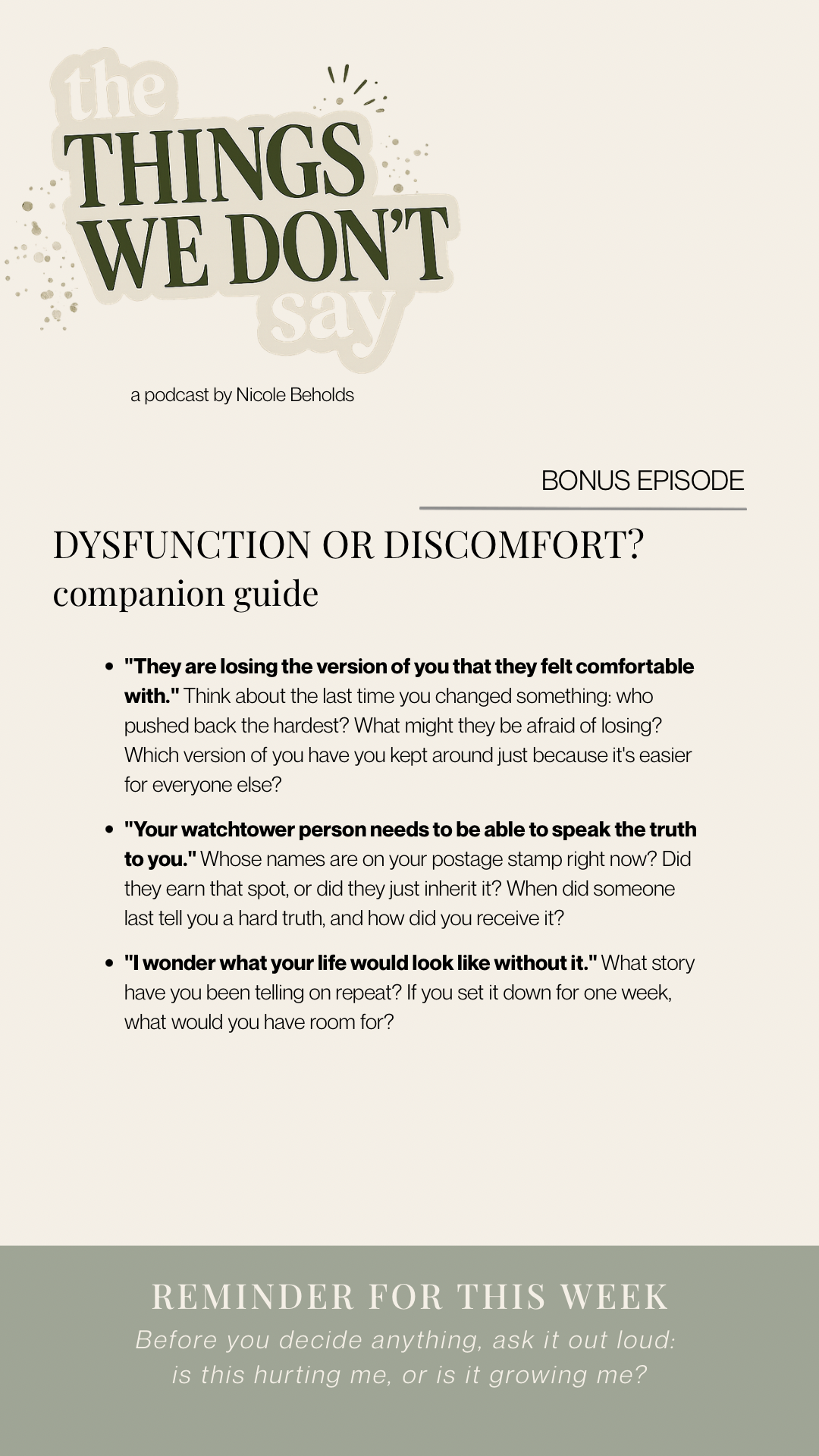
Bonus episode: dysfunction or discomfort
Not every hard thing is a harmful thing. In this bonus follow-up to Episode 10, my friend Jen Stovall, a life coach with Mustard Seed Living, sat down with me and brought the one question she asks over and over: is this dysfunction, or is it discomfort? We talk about the lock on your front door, who gets a spot in your watch tower, why that list should fit on a postage stamp, and the curious question that changed Jen’s life.
ACTION STEPS THIS WEEK
Sort one situation you keep going back and forth on with Jen’s worksheet: mostly discomfort, mostly dysfunction, or a little of both.
Write your postage stamp: the few names you’d trust to tell you a hard truth. Save it as a favorite in your phone.
Listen for “should” on repeat this week, the ones you say about yourself and the ones you say about other people. Write one down.
Plan your next hard conversation in three parts: what I’m experiencing, one example, and what it could look like if we both work on it.
Ask one curious question before you call something dysfunction: are they trying to hurt me, or are they just not my cup of tea?
GO DEEPER
Dysfunction or Discomfort? Worksheet: Jen’s one-page reflection for sorting what you’re feeling, what’s yours and what isn’t, and your next right step.
The Art of Soft Separation: Jen’s ten-step guide to staying connected without losing yourself: how to stop over-explaining, stop keeping score, and decide what access looks like, without announcing a boundary or closing your heart. As Jen puts it, “It’s not about caring less. It’s about carrying less.”
The Extended Cut: the parts of our conversation I couldn’t fit in the episode, including holidays with adult kids and finding your watch tower people.
A Session with Jen: one full coaching session, on her, for my listeners. Message @mustard_seed_living on Instagram and tell her you heard her on the podcast or send her an email at Mustardseedlivingcoaching@gmail.com
Access Map (from Episode 10): a printable page to see who has access to what parts of your life.
EPISODE 9: WHO TOLD US THIS WAS NORMAL?
DOWNLOAD THE COMPANION GUIDE
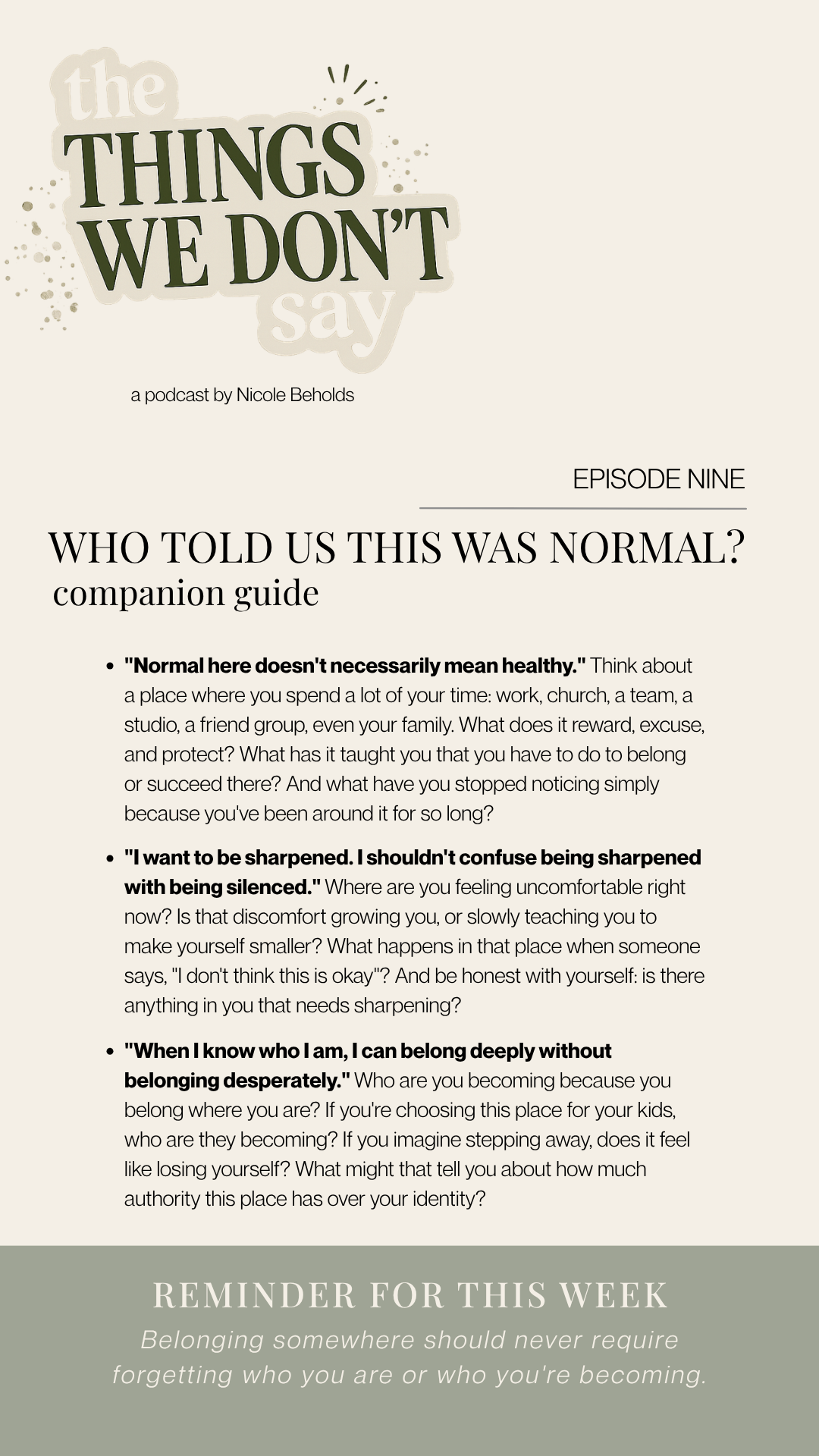
This is the Companion Guide that goes with Episode 9, where I talked about culture: how the places we spend our time quietly shape what we call normal, and how to tell whether a place is sharpening you or shrinking you.
Maybe you love where you are and want to make it even better. Maybe something has felt off for a while and you’re not sure whether to say something, stay, or go. Maybe you’re watching a place your kid loves and quietly collecting red flags. Whatever brought you here, open the guide, and your mind. Take your time with this. There are no wrong answers, only honest ones.
Oh! And, I thought it’d be fun to have a few things to practice this week:
Name one unwritten rule. Pick a place you spend a lot of time and finish this sentence: “Everybody here knows you don’t ___.” Then ask yourself whether it’s a rule you’d actually choose.
Ask one curious question. The next time something doesn’t sit right, try, “Can you help me understand this?” Then pay attention to what happens next.
Ask your kid a better question. Skip “How was practice?” and try “What happens there when somebody makes a mistake?” Then just listen. No interrogating.
Make something good normal. Pick one healthy thing, like saying thank you, owning a mistake out loud, or celebrating someone else’s win, and repeat it every day this week. That’s how culture starts.
Episode 8: THE SHIRTS IN MY DRESSER
DOWNLOAD THE COMPANION guide
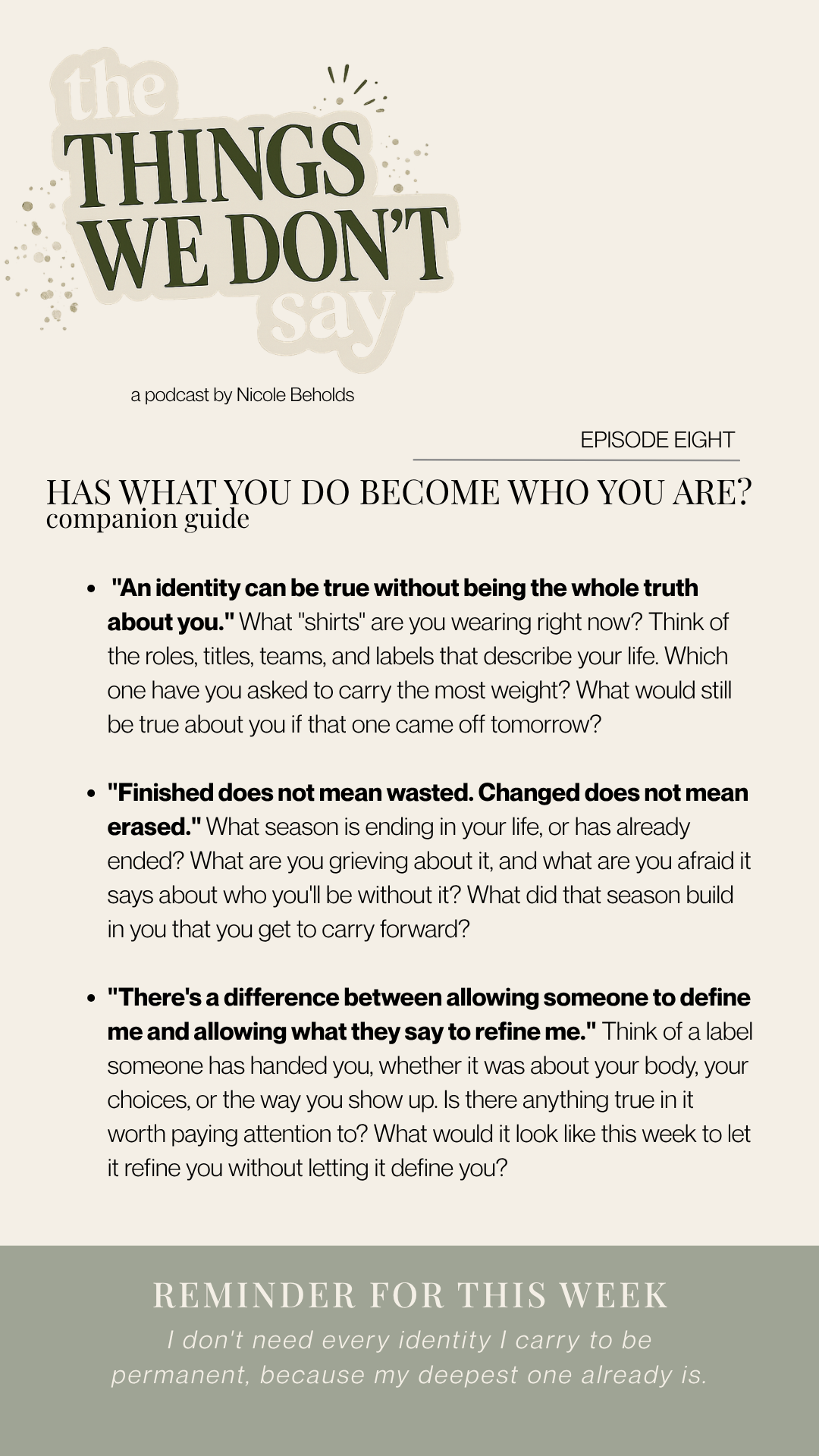
This is the Companion Guide that goes with Episode 8, where I talked about what happens when a role, a season, or a label starts carrying more of our identity than it was ever meant to.
Maybe you’re a homeschool mom thinking about public school. Maybe you just watched your senior walk off the field for the last time. Maybe someone handed you a label years ago and you’re still wearing it. Whatever brought you here, grab a coffee and a pen. Take your time with this. There are no wrong answers, only honest ones.
Oh! And, I thought it’d be fun to have a few things to practice this week:
Swap one label for a sentence. Catch yourself saying “she’s the ___ one” about someone you love. Try “sometimes she ___” instead, and leave the door open.
Write a “carry forward” list. Pick one season that’s ending or has ended. Write down three things it built in you that are coming with you.
Ask one brave question. Ask someone close to you, “Is there something you keep experiencing from me that I might not see?” Then just listen. No defending.
Start with whose you are. Each morning this week, before any other title, say it: “I belong to Jesus.” Then go put on whatever shirt the day needs.
EPISODE SEVEN: I’ve got it: The mental load We carry
What’s Open In Your Browser? (Companion Guide)
MENTAL LOAD TEST from Initiative equal care
fair play by Eve Rodsky
What’s taking up space in your brain right now?
This week we’re talking about the mental load—the things we’re remembering, anticipating, monitoring, preventing, and waiting on while still trying to live our actual lives. But we’re also taking the conversation one step further: just because we’re still functioning, does that mean we actually have the capacity to carry everything we’re carrying?
This week’s Backstage Pass includes the What’s Open in Your Browser? Mental Load Check-In to help you get those tabs out of your head and decide what needs to stay, be shared, handed off, waited on—or closed completely.
Because the goal isn’t to get better at carrying everything. It’s to get better at knowing what actually deserves to stay open.
EPISODE six: The cost of making it work
DOWNLOAD THE COMPANION guide
What if the problem isn’t that our calendars are full— but that we’ve gotten really good at making everything fit? Use this guide to take an honest look at what your yeses are costing you, what might need protecting, and whether making it all work is actually working.
EPISODE Five: I Need you to know…
DOWNLOAD THE COMPANION GUIDE
The people who know us best still can’t read our minds. This guide helps you look at the things you’ve been hoping someone would just know— and what might change if you actually said them out loud.
EPISODE FOUR: I HOPE SHE WINS
DOWNLOAD THE COMPANION GUIDE
What happens when someone else gets the thing you wanted? This week, we’re talking scoreboards, comparison, and learning to celebrate someone else without calculating what their win means about you. Because your disappointment can be real and you can still become someone who cheers obnoxiously loud.
A little note from Mom:
Hannah and Elsie were excited to share this with you, and I’m protective of the fact that these are their little voices and their stories. Please enjoy this bonus here on the Backstage Pass, but don’t download, record, repost, or share clips of their audio elsewhere. Thanks for helping me keep this safe place for them to be themselves.
THE LAUNCH EPISODES
Episode 1: FIVE MORE MINUTES
Download the companion guide here.
What if the moments we’re rushing through are the very ones we’ll someday wish we could get back? In the very first episode of Things We Don’t Say, I invite you into an ordinary morning—the snooze button, the unfinished plans, the cold coffee, and the interruptions that feel inconvenient in the moment. Maybe the ordinary moments aren’t interruptions at all. Maybe they’re invitations—to slow down, pay attention, and notice the people and stories right in front of us.
Sometimes the words come later. And sometimes… all it takes is five more minutes.
Episode 2: The best yes
Download the companion guide here.
I know exactly where you think this episode is going. Trust me. You’re wrong. Somewhere between Betty (yes, I named my phone), a swim meet, and one very inconvenient parenting moment, I discovered this conversation had almost nothing to do with my phone.
Every day we’re giving our “yes” to something. The question isn’t whether we’re saying yes—it’s who or what is getting it. The things that deserve our best often lose to the things that are simply easiest to reach. But when we intentionally choose who gets our attention, we become the kind of people who make others feel seen.
Episode 3: Who I thought I’d Be
Download the companion guide here.
Who did you think you’d be by now? On my 40th birthday, I’m looking back at the versions of myself I thought I’d become—and the expectations, disappointments, and unexpected turns that shaped who I actually am.
From a questionable relationship with anti-aging cream to career changes, church ministry, old birthday blogs, and the quiet grief of a life that didn’t go exactly as planned, I’m asking what might be underneath our tendency to compare.